
The Joy of Hardy Cyclamen
Janine Thompson from Heartsease Plants based in West Wales, shares her passion for these hard working little beauties - 06 March 2026
While I’ve known of the existence of Cyclamen as a genus for a long while, my interest in them has definitely been a ‘slow burn’. Like many of you, I was attracted to the vibrant jewel tones that you can brighten the inside of your house with (Cyclamen persicum selections) and the bedding varieties for the pots on my front doorstep. Then I felt disappointed, as I overwatered the indoor ones causing them to die and the bedding ones succumbed to a cold period.
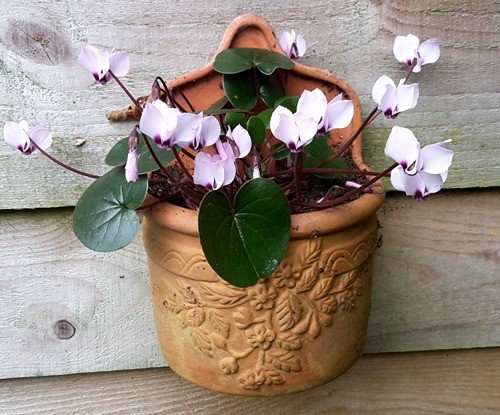
A couple of chance visits to gardens were what really sparked my interest in them. A few decades ago, I visited a friend who is a Galanthophile who was working at the spectacular gardens of Colesbourne Park for their February Snowdrop Open days. Despite the vast carpets of snowdrops, my interest was captured by a small Cotswold stone trough, which had been filled with an eye-catching mix of hardy Cyclamen coum in varying shades and leaf forms and an interplanting of Snowdrops with interesting green markings. I don’t know if it was the simplicity but effectiveness of the combination or the small scale of it, making it accessible for even the smallest garden, that captured my imagination.
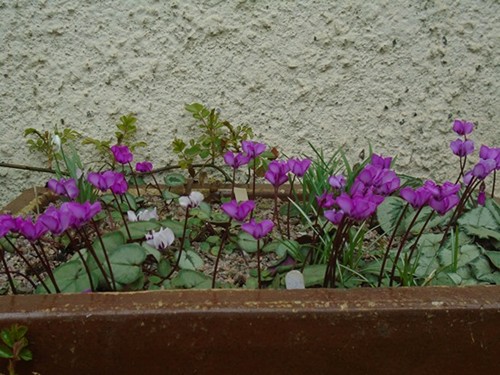
I soon replicated the combination in my own garden with a selection of old sinks, adding interesting Crocus or Hoop Petticoat Daffodils to the mix, topped with alpine grit. I quickly discovered the variety of Cyclamen coum and their many varieties with silver or pewter leaves, silver with a green Christmas tree marking in the centre and many, many more green and white variations. The flower colour varying between an ice-catching magenta – pink, soft and more pearlescent pinks and white, often with a maroon ‘nose.’ A later visit to Rodmarton Manor inspired me to raise my sinks onto tables for ease of inspection, admiration and then for the removal of the seedlings which appeared to pot them on. It doesn’t seem to matter how many years have passed since that first sight of them in the trough, their resilience in the worst and coldest of weather, even though they are such a diminutive plant. They like semi-shade, reasonable drainage, (being a small corm, rotting can be a danger), but are hardy and will often seed around to form a carpet.
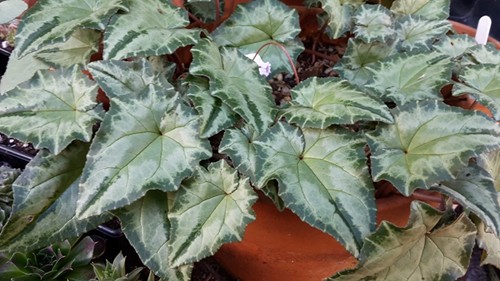
My next lightning bolt was a visit involving another Galanthophile, this time Roger Norman and his Herefordshire garden, Ivycroft, (open through the NGS). While exploring his lovely garden and admiring his stunning snowdrops, I came across a planting of Cyclamen hederifolium. Not in flower in February of course, but extremely eye-catching with their amazing variation in leaf form and marking. Even without flower (these bloom between July and October for me), the display was superb. I soon delved into learning the forms and named varieties of these too, astounded by what is perhaps an even greater diversity of leaf form than my initial favourite C. coum. The flowers being similar shades of pink and white to C. coum with some darker ‘red’ forms such as C. hederifolium ‘Corfu Red’ and also some interesting curiosities like C. hederifolium ‘Stargazer’ whose flowers are upside down, pointing skywards.
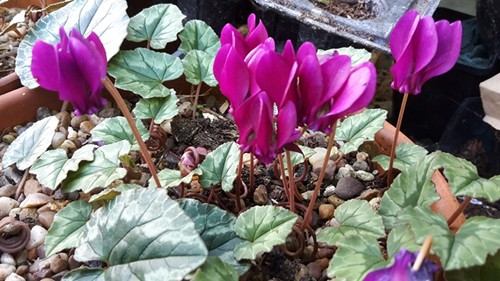
I started adding these to old sinks too, but their larger size does not allow you to keep as many forms in a sink as you may like, so in the ground may be preferable. They like semi-shade and a good soil, though will tolerate some heaviness I have discovered and will seed around too. The Rare Plant Fair at Llanover House is a good place to see them grown in drifts under trees and shrubs.
The common name of C. hederifolium being the Ivy leaved Cyclamen certainly does not do them justice, for the variation in Ivy leaves has nothing on these! (Ed – now there’s a good debate for a rainy day!) While I have collected many different named varieties and forms, if I wished to sell them as named varieties, I would have to keep them separate to avoid cross-pollination and be ruthless in removing rogue seedlings to keep the strain pure. This, strangely for me, has never appealed and I much prefer grouping distinct forms together and seeing what they produce. I find it much more exciting to see what pops up.
As a nurserywoman there are so many plants I love to grow and share with others. I find my only problem with the hardy Cyclamen is parting with the babies as it’s so easy to persuade myself that I should keep that one as it’s different to the others! So, I invite you to explore these hardy beauties and see which leaf forms and flowers you like the best. For more information you could consider joining that great resource which is The Cyclamen Society too.
Fairs
Past Fairs:
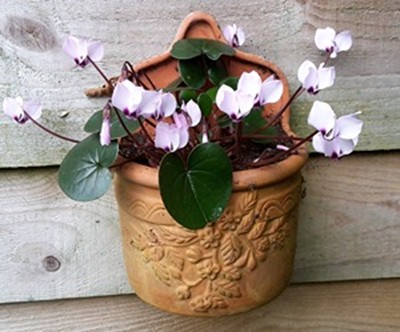 The joy of Hardy Cyclamen - Read More..
 Wildflowers in Practice - Read More..
 Why Social Media matters to small nurseries – and how to use it without losing your mind - Read More..
 Handy Plants for Climate Change - Read More..
 Hard-working Plants for Late Summer and Autumn Colour - Read More..
