
Thyme and Friends in the Garden & Kitchen
by Catherine Bond, CB Plants, Severalls Nursery, just outside Crewkerne in beautiful South Somerset, close to the Dorset border. - 26 June 2026
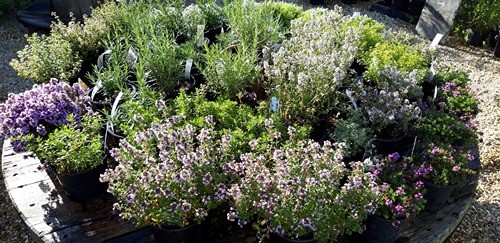
Selection of thymes
Softening the edges of paving, growing in pots handy to the kitchen, or carpeting a green roof that's attractive to pollinators, there are many different varieties and forms of thyme to choose from.
Historically, thyme has been used by humans since ancient times, for adding flavour to foods, medicinally for it's antibacterial qualities, and as an aromatic strewing herb and essential nosegay to ward off disease and plague. The Egyptians used thyme oil for embalming and the Greeks burnt it as incense in their temples. It is thought that the Mediterranean forms of Thymus that we now value for culinary and commercial use were brought to us by the Romans, while the native Thymus praecox subsp. britannicus can be found growing across the British Isles on thin upland and coastal grasslands, cliffs, heaths and ledges where there is little competition from taller plants.
In the garden thymes require those same well drained, open sunny conditions to do well, a gravel mulch is beneficial, and if your soil is at all on the heavy side they are definitely best grown in containers or raised beds. Shrubby and mound forming varieties can be used as an edging to beds or a formal parterre, Thymus vulgaris, common thyme is the classic choice for culinary use with its small dark aromatic leaves and pinkish-white flowers that are so attractive to bees. Regular trimming is the secret to preventing the plants becoming leggy and woody, The compact form Thymus vulgaris 'Compactus' is excellent, with dense foliage and when used in formal situations it's neat round shape of about 25 cm gives a little height amongst more ground hugging varieties, its flavour is just as good as common thyme bringing a fragrant summery savouriness at any time of year. Although evergreen, I always dry some of the trimmings when cutting back in summer to use once growth slows down in the cooler months.
Broad-Leaved Thyme, Thymus pulegioides, is an excellent alternative to common thyme for cooking and an attractive garden plant too. The relatively large dark green rounded leaves are carried on lax stems 10-15 cm high, the semi trailing habit creates a ground covering mat that doesn't get woody like the shrubby thymes do. 'Tabor' is a named form and 'Foxley' is variegated, the pink flowers being extremely pretty.
Thymus citriodorus, Lemon Thyme is a favourite with chefs especially when used with poultry or fish and for flavouring dressings, drinks and syrups, it's oval dark green leaves smell strongly of lemon, the creeping form is very effective spilling out of a container especially when smothered with it's pink flowers. 'Silver Queen' is the well known variegated form with pale pink flowers.
Thymus fragantissimus, Orange Thyme is delightful, upright and bushy with small silvery- green leaves and pale pink flowers in summer, it dries brilliantly, and I love it in soups and with roasted vegetables in summer or winter.
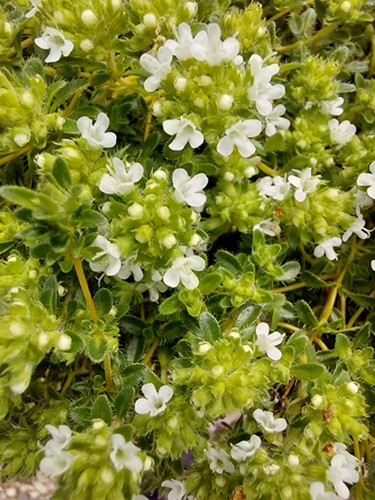
Thymus Snowdrift
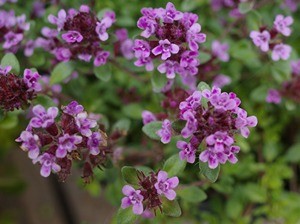
Thymus Wine and Roses
Of the spreading, prostrate forms, Caraway Thyme, Thymus herba-barona has a remarkable caraway scent, the small dark green leaves cover trailing stems that are studded with many pale pink flowers in summer, Thymus coccineus 'Creeping Red' forms a dense carpet as do forms of Thymus serpyllum, 'Snowdrift' has tiny white flowers against bright green leaves and 'Russetings' has russet-toned foliage and pink flowers. I particularly like 'Ruby Glow' with ruby-red flowers and 'Cabon Wine and Roses' rose pink flowers. One last thyme I must mention is Woolly Thyme, Thymus pseudolanuginosus, ground hugging, tactile soft 'woolly' grey-green leaves and very pretty pale pink flowers in summer, it is surprisingly tough and hardy for me on well drained soil.
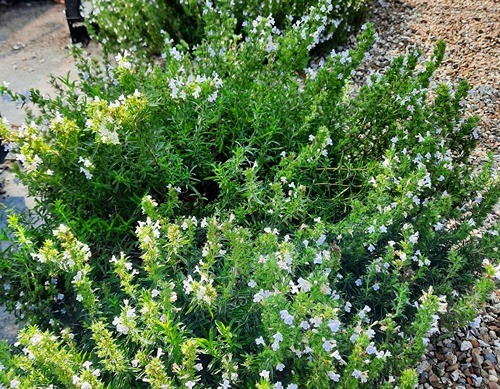
Winter Savory - Satureja montana
There are two other plants I grow that aren't thymes but originate from the Mediterranean region and are associated with them for different reasons. Winter Savory, Satureja montana is an evergreen woody based herb with narrow dark green aromatic leaves that have a strong peppery-thyme flavour, it is associated with beans and is said to aid their digestion. Growing to 30cm, the plant is covered in attractive small white flowers in summer that are loved by bees. It's a herb I grow and use alongside thyme year round.
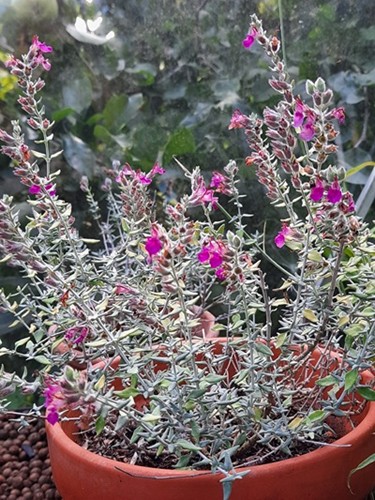
Cat Thyme - Teucrium marum
Cat Thyme, Teucrium marum, is a small silvery-leaved subshrub with magenta-pink flowers and is highly aromatic. It is similar in appearance to thyme but with a strong musty fragrance that some cats adore and others ignore. Coming from rocky areas of southern Spain, Teucrium marum needs sharp drainage and is a choice plant for a rockery or a pot.
Website: www.cbplants.co.uk
Fairs
Past Fairs:
 Share our Enthusiasm for Echinacea - Read More..
 Fabulous Fronds - Start of our Journey - Read More..
 2027 Rare Plant Fair Dates - Read More..
 Fonthill House Garden - Read More..
 Thyme and Friends in the Garden & Kitchen - Read More..
