Share our Enthusiasm for Echinacea
Tim Hancock and Rebecca Flint, Tortworth Plants Ltd who are based in Gloucestershire - 21 August 2026
At Tortworth Plants, we grow a wide range of different plants, including a selection of the ever-popular genus Echinacea, which we will be focussing on in this article. The generic name is derived from the Greek, meaning “hedgehog”, which relates to the spiny central cones that are a distinguishing feature of the genus and inspire the common name of Coneflower.
There are ten species of Echinacea, all native to North America. From these, many new and different varieties have been bred, in a diverse range of colours and forms. Many of the new varieties are covered by Plant Breeders’ Rights, which prohibit unlicensed propagation for resale. We buy plugs of these varieties from licensed propagators, who charge a royalty, which is paid back to the breeder. Of course, this does not stop you from dividing plants at home, for use in your own garden.
Echinacea are now a familiar feature of many gardens and have become especially popular in “prairie-style” plantings, inspired by the designers like Piet Oudolf. A good place in the South West to draw inspiration for this style of planting, where Echinacea have been used, is Hauser and Wirth, in Bruton, Somerset. We very much enjoyed visiting this garden a few years ago, and seeing Echinacea planted in combination with grasses and other perennials, that look their best in late summer and autumn.
They are loved for their large, bold flowers and bright colours, over a long flowering period, and are also a magnet for bees and butterflies. Generally speaking, Echinacea are best grown in full sun, although many varieties will tolerate some partial shade. They require a fertile, but free-draining soil, as they particularly dislike winter wet. Their seedheads attract goldfinches in the autumn, and are long-lasting, often being retained throughout winter, so this affords two benefits – the aesthetic and the practical – as it is generally best to cut Echinacea back in spring, rather than autumn, to provide some additional protection to the crown over the winter. We have found that over the years, some breeding selections for colour and type have resulted in weaker, less hardy varieties, so we have trialled and chosen varieties for our range that we feel are stronger and reliable in the garden.
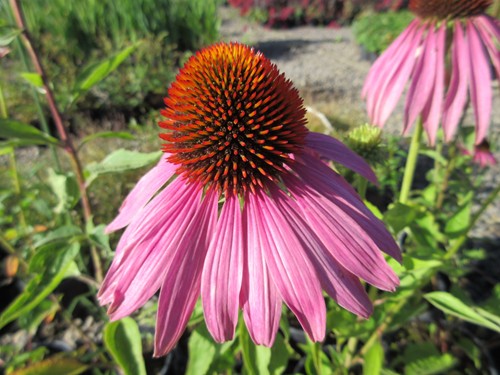
E. purpurea 'Magnus'
Most of the varieties grown today are derived from the species Echinacea purpurea, which is also renowned for its medicinal properties. E. purpurea ‘Magnus’ is a popular and reliable garden variety, which is similar to the species, with rich pink flowers, reaching a height of about 1m.
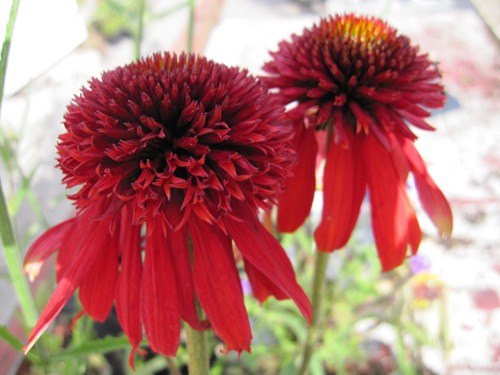
E.'Eccentric'
There are now a wide range of varieties that have been developed for even showier, double flowers, which make even more of a feature of the central cones. One of our favourites is E. ‘Eccentric’, which is a beautiful deep orange-red, flushed with shades of purple, and grows to approximately 60cm tall.
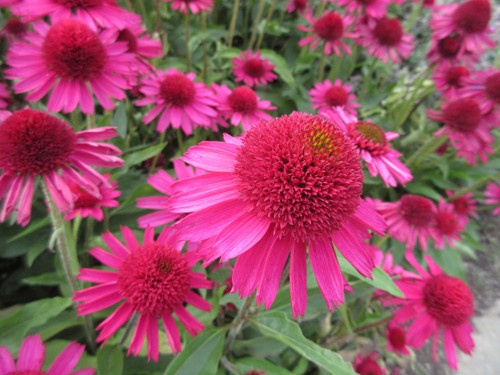
E.'Delicious Candy'
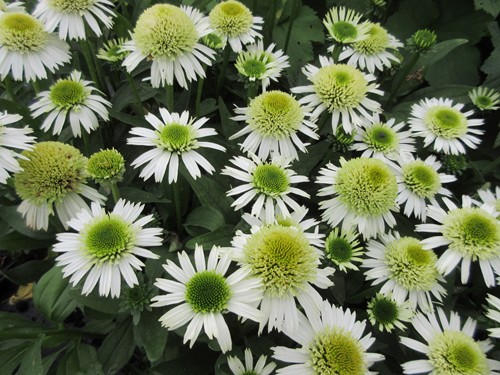
E.'Delicious' Nougat
There is also the “Delicious” series, which are all very bushy, compact varieties that produce masses of large flowers – Delicious Candy, Delicious Nougat and Delicious Strawberry. The latter is a new variety to us that we are trialling this year, so we are looking forward to seeing it come into flower, and should have stock available for sale in the autumn.
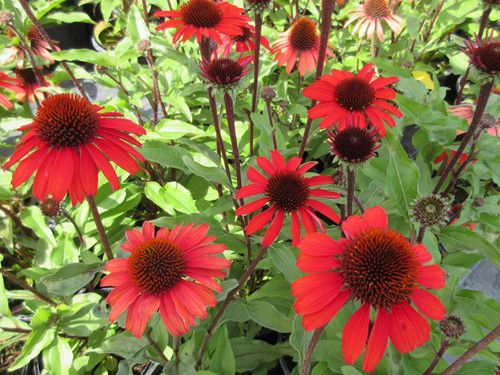
E.'SunSeekers Orange'
Another range worth mentioning is the SunSeekers varieties, which have been selected for their compact, branching nature, strong habit, and prolific flowering. Being shorter, at about 50cm in height, these are also perfect for growing in pots. We particularly love the deep, rich orange of E. SunSeekers Orange.
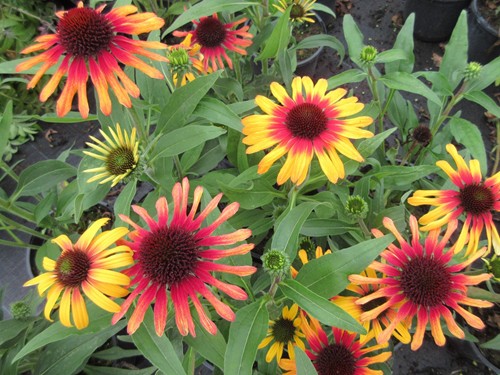
E.'SunSeekers Tequila Sunrise'
E. SunSeekers Tequila Sunrise has a gorgeous two-tone flower, with golden yellow petals, flushed with red from the centres.
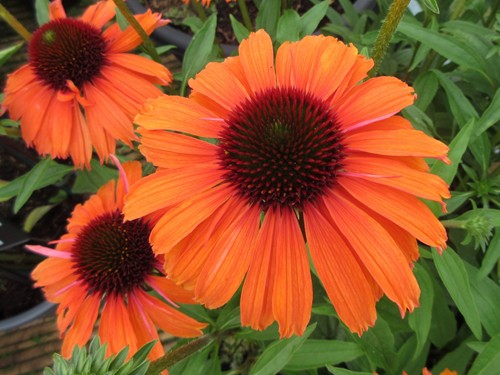
E.'SunSeekers Mineola'
E. SunSeekers Mineola has a slightly different flower form, with a semi-double layer of bright orange petals, giving a more flamboyant effect.
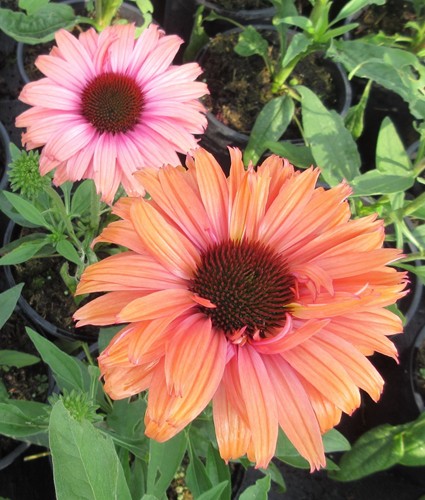
E.'SunSeekers Rainbow'
And for something different, there is E. SunSeekers Rainbow, which is another semi-double variety, with flowers that range through shades of peach, salmon, orange and pink as they age, giving a wonderful multicoloured display.
Finally, we have a different species altogether – E. pallida. This variety has a beautiful, delicate look, growing to about 1.2m tall, with long, narrow, strongly reflexed petals in pale pink.
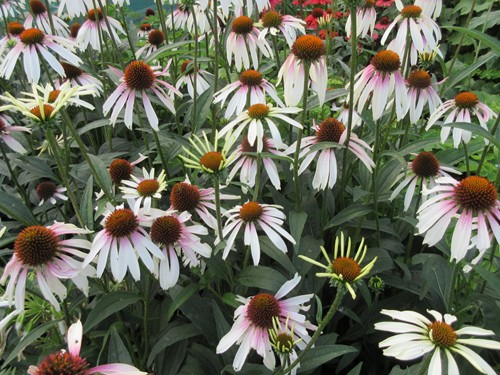
E.'Pretty Parasols'
E. Pretty Parasols is believed to be descended from E. pallida, and is a personal favourite of mine. It was discovered as a chance seedling in Belgium in 2013 and is tall and airy, with unusual two-tone flowers. The heavily reflexed petals are pure white, with a deep pink flush spreading from the central cone. It grows to about 90cm in height.
We hope you share our enthusiasm for Echinacea, and why not give them a go in your own garden, either in the border, or in pots.
Website: www.tortworthplants.co.uk
Fairs
Past Fairs:
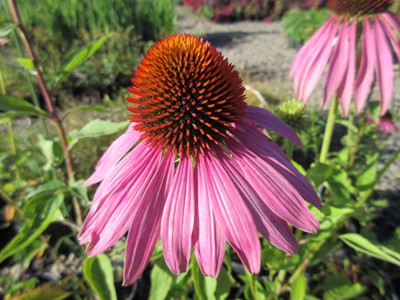 Share our Enthusiasm for Echinacea - Read More..
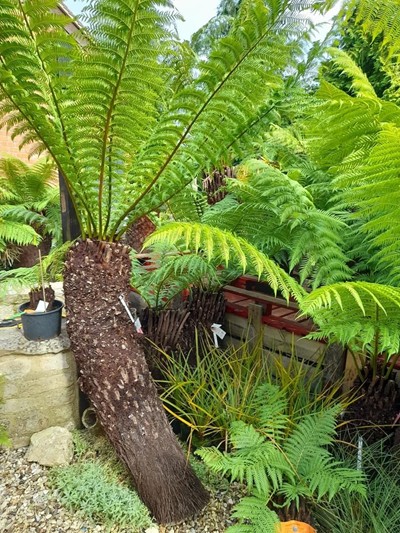 Fabulous Fronds - Start of our Journey - Read More..
 2027 Rare Plant Fair Dates - Read More..
 Fonthill House Garden - Read More..
 Thyme and Friends in the Garden & Kitchen - Read More..
